design:os · docs
Working from more than one computer
A recommended setup for one designer-owner who runs this bridge on two or more Macs (for example a laptop on the move and a desktop that runs agents in the background) against the same Figma files. It is distilled from a production case study (two Macs, several agents, one 400k-node Figma file, in daily use since September 2026). Adapt the names; keep the invariants.
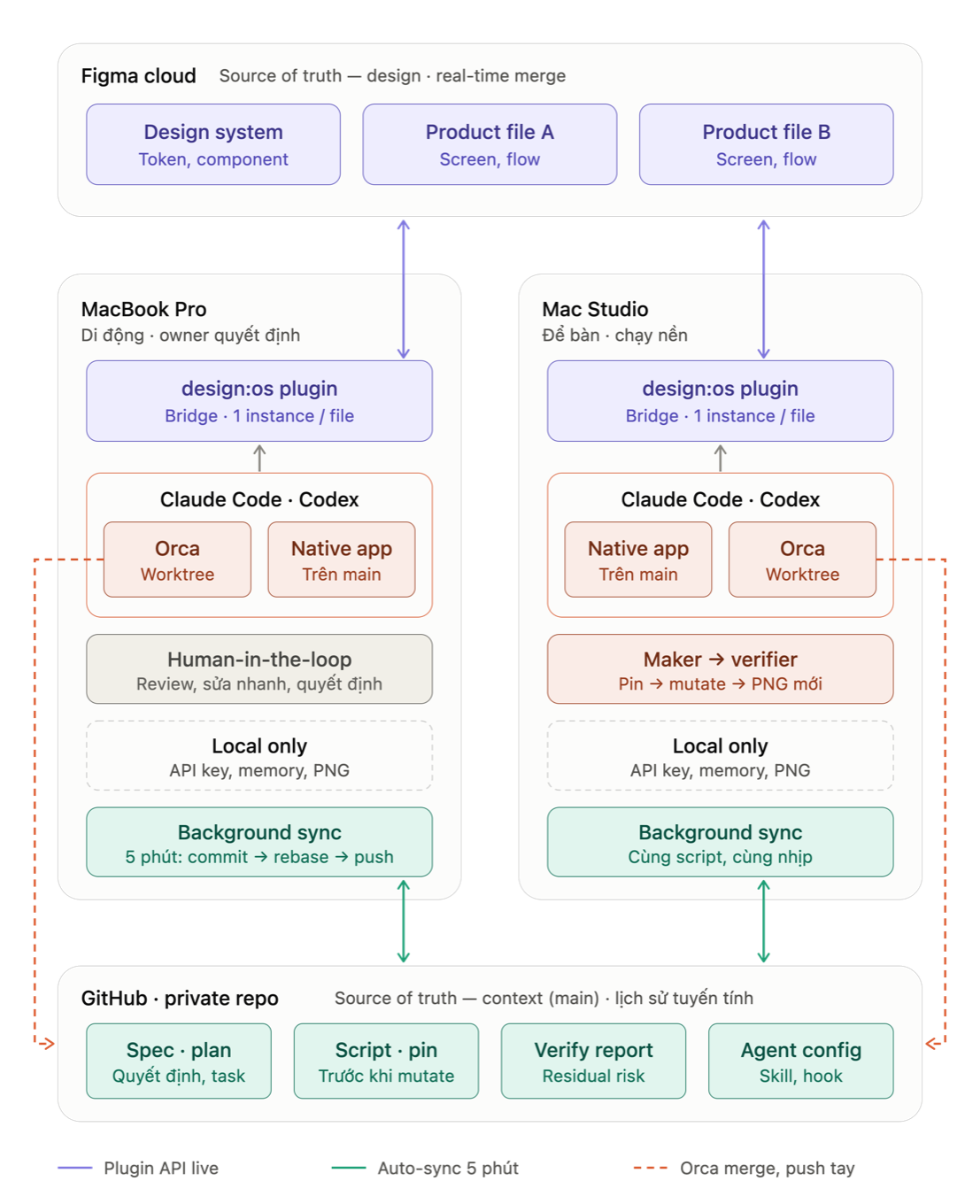
The two planes of truth
| Plane | Lives in | Synced by | Never copied into |
|---|---|---|---|
| Design (frames, components, variables) | Figma cloud | Figma, in real time, through each machine’s own plugin instance | Git |
| Context (specs, plans, scripts, pins, verify reports, agent config) | One private Git repo, branch main |
A background commit, rebase, push loop on every machine |
Figma |
Figma never travels through Git. Two machines edit the same file through the Plugin API and Figma reconciles them live; Git carries only what was decided, what script ran, what the canvas looked like before the mutation (a pin), and what could not be verified (a report).
What stays on each machine
Put these in .gitignore of the project repo. They are secrets, caches, or regenerable:
# secrets — recreate per machine
figma-key.md
.env
.env.*
*.pem

# per-machine agent state
.claude/settings.local.json

# dependencies / build output
node_modules/
dist/

# session transcript archives (hundreds of MB, per machine)
.brv/context-tree/session-handoffs/archive/

# raster verify shots — the Figma file is the source; a verifier always takes a fresh capture
*.png
*.jpg
*.gif
*.webp

.DS_Store
*.log
Two consequences worth writing down for your agents:
- Durable knowledge goes through tracked files (
docs/,plans/, a handofflatest.md), never through an agent’s private memory directory. Memory is a per-machine cache. - A verifier never trusts another machine’s screenshot. It captures its own, on its own plugin instance, after the mutation.
The five-minute sync loop
One script, committed in the repo, run by launchd on every machine. It never guesses on conflict.
#!/bin/bash
# scripts/git-auto-sync.sh — commit local changes, rebase onto origin/main, push.
# On a rebase conflict: abort, keep local commits, post one notification, retry
# silently each tick until you run `git pull --rebase origin main`, resolve, push.
set -u
REPO="$(cd "$(dirname "$0")/.." && pwd)"
NAME="$(basename "$REPO")"
LOG="$HOME/Library/Logs/$NAME-sync.log"
LOCK="/tmp/$NAME-sync.lock"
MARKER="$REPO/.git/sync-conflict"
HOST="$( (scutil --get LocalHostName 2>/dev/null || hostname -s) | tr '[:upper:]' '[:lower:]')"
NOW="$(date '+%Y-%m-%d %H:%M')"

log() { printf '%s [%s] %s\n' "$(date '+%F %T')" "$HOST" "$*" >> "$LOG"; }
notify() { osascript -e "display notification \"$1\" with title \"$NAME sync\"" 2>/dev/null || true; }

mkdir -p "$(dirname "$LOG")"
if ! mkdir "$LOCK" 2>/dev/null; then log "skip: another sync running"; exit 0; fi
trap 'rmdir "$LOCK" 2>/dev/null' EXIT
cd "$REPO" || { log "error: repo missing at $REPO"; exit 1; }

# another tool is mid-operation: wait for the next tick
for f in index.lock rebase-merge rebase-apply MERGE_HEAD CHERRY_PICK_HEAD; do
  [ -e ".git/$f" ] && { log "skip: git busy (.git/$f)"; exit 0; }
done
[ "$(git rev-parse --abbrev-ref HEAD)" = "main" ] || { log "skip: not on main"; exit 0; }

# 1. snapshot local changes
git add -A
if ! git diff --cached --quiet; then
  git -c commit.gpgsign=false commit -q -m "chore(sync): $HOST $NOW" && log "commit: $(git rev-parse --short HEAD)"
fi

# 2. bring in the other machine's work
if ! git fetch -q origin main 2>>"$LOG"; then log "skip: fetch failed (offline?)"; exit 0; fi
if [ "$(git rev-parse HEAD)" != "$(git rev-parse origin/main)" ]; then
  if git rebase -q --autostash origin/main >>"$LOG" 2>&1; then
    [ -e "$MARKER" ] && { rm -f "$MARKER"; log "conflict resolved"; notify "Conflict resolved, sync resumed"; }
    log "rebased onto $(git rev-parse --short origin/main)"
  else
    git rebase --abort 2>/dev/null
    log "CONFLICT: rebase aborted; local commits kept. Resolve: git pull --rebase origin main"
    [ -e "$MARKER" ] || { touch "$MARKER"; notify "Rebase conflict on $HOST. Run: git pull --rebase origin main"; }
    exit 0
  fi
fi

# 3. publish
if [ "$(git rev-parse HEAD)" != "$(git rev-parse origin/main)" ]; then
  if git push -q origin main >>"$LOG" 2>&1; then log "pushed $(git rev-parse --short HEAD)"; else log "push failed (see above)"; fi
fi
Install it once per machine, after cloning:
#!/bin/bash
# scripts/install-git-auto-sync.sh — register the launchd agent for THIS machine.
# Remove: launchctl bootout gui/$UID/<label> && rm ~/Library/LaunchAgents/<label>.plist
set -eu
REPO="$(cd "$(dirname "$0")/.." && pwd)"
NAME="$(basename "$REPO")"
LABEL="com.$(id -un).$NAME-sync"
PLIST="$HOME/Library/LaunchAgents/$LABEL.plist"
LOG="$HOME/Library/Logs/$NAME-sync.log"
chmod +x "$REPO/scripts/git-auto-sync.sh"
mkdir -p "$HOME/Library/LaunchAgents" "$HOME/Library/Logs"
cat > "$PLIST" <<PLIST
<?xml version="1.0" encoding="UTF-8"?>
<!DOCTYPE plist PUBLIC "-//Apple//DTD PLIST 1.0//EN" "http://www.apple.com/DTDs/PropertyList-1.0.dtd">
<plist version="1.0"><dict>
  <key>Label</key><string>$LABEL</string>
  <key>ProgramArguments</key><array><string>/bin/bash</string><string>$REPO/scripts/git-auto-sync.sh</string></array>
  <key>WorkingDirectory</key><string>$REPO</string>
  <key>StartInterval</key><integer>300</integer>
  <key>RunAtLoad</key><true/>
  <key>EnvironmentVariables</key><dict>
    <key>PATH</key><string>/opt/homebrew/bin:/usr/local/bin:/usr/bin:/bin</string>
    <key>HOME</key><string>$HOME</string>
  </dict>
  <key>StandardOutPath</key><string>$LOG</string>
  <key>StandardErrorPath</key><string>$LOG</string>
</dict></plist>
PLIST
launchctl bootout "gui/$UID/$LABEL" 2>/dev/null || true
launchctl bootstrap "gui/$UID" "$PLIST"
echo "installed $LABEL -> $REPO (every 5 min, log: $LOG)"
What the loop guarantees:
- Linear history. Rebase, never merge commits;
git log --onelinestays one straight line. - Snapshots, not feature commits.
chore(sync): <host> <time>every five minutes onmain. Real feature commits appear only when a worktree is merged by hand. - Conflicts stop and tell you. The script aborts the rebase, keeps your local commits, posts one
macOS notification, then retries quietly every tick. You resolve with
git pull --rebase origin main. - Offline is a skip, not an error. A failed fetch waits for the next tick; nothing is lost.
- Worktrees are exempt. The loop only runs on
main; a branch checked out in a worktree is a workspace, and merging it is a deliberate gate. Delete the remote branch after the merge.
Cost per tick with nothing to do: one git fetch. With changes: commit, rebase, push, under five seconds.
Splitting roles between machines
The setup in the diagram assigns roles; the bridge itself does not care which machine does what.
| Machine | Role | Why |
|---|---|---|
| Laptop | Owner sits here: reviews comments, makes quick edits, decides | Human-in-the-loop lives where the human is |
| Desktop | Runs a maker worker and an independent verifier, each in its own worktree | Long background runs, isolated file ownership |
Three rules the verifier follows, taken from real reports:
- Pin before mutating. The maker snapshots the name, size, and child count of every master it will
touch into a
pin.json. The verifier compares against the pin, not against the maker’s report. - Fresh capture only. The verifier takes its own screenshots after the mutation; the maker’s screenshots are treated as claims.
- “What could not be verified” is the first section of every verify report, with a residual-risk column, so the owner can decide from the first five lines.
Bridge state: what is shared and what is not
Each machine runs its own broker on loopback and its own imported plugin, so each machine has its own
instanceId for the same Figma file. Always take --instance from status on the machine you are
typing on; an instanceId copied from the other machine’s shell will not resolve.
The bound capture feed and the binding record live inside the project directory
(design/changes/<fileKey>.jsonl, design/figma-bind.json) and are tracked, so a designer edit
captured on one machine is readable with changes --owner-only on the other after the next tick.
The feed is append-only JSONL; if both plugins capture the same file between two ticks, the rebase
can conflict at the tail. The loop stops and notifies as designed; keep both hunks when resolving.
Known gaps
- No “who holds this plan” flag yet. If both machines open a session on the same plan directory,
the sync will conflict on its handoff file. A line
OWNER: <host>at the top of the plan is the cheapest fix; enforce it by convention. - Hostnames. If
scutil --get LocalHostNameis empty, commits arrive under a placeholder name. Set it once withsudo scutil --set LocalHostName <name>. - Figma has no backup beyond version history. Save a named version before each package of mutations; a periodic export is still an open item.